The Sicilian Table: Lo Sfincione

.jpeg)
This is the second edition of The Sicilian Table: Scacce & Stories, and I’m delighted to share a recipe rooted in a bread-based tradition, this time from Palermo: lo sfincione.
You would be right in thinking that it doesn’t sit neatly alongside scacce or impanate, even though it carries that same deeply rooted sense of place. Rather, it sits beside them; a reminder that each town has its own expression of something baked, folded, filled, or topped. In Palermo, that expression takes the form of sfincione, a tradition that comes with a story close to my guest contributor’s heart.
When Lindsay Marie Morris shared her story with me, it was clear that it wasn’t only about sfincione — the Palermitan-style pizza of Sicily, but also about migration, separation, letters that could no longer be sent, and a love that endured across war and distance.
Lindsay begins by tracing her connection to Sicily and the lives lived between two places. Her story unfolds through her grandparents, and the journeys that carried them between Sicily and America.
My name is Lindsay Marie Morris, but don’t let my Anglo name fool you. I am mostly Sicilian by way of my mother’s family. Her parents grew up in the neighboring villages of Porticello and Santa Flavia, near Palermo.
My grandmother Concetta, was born in Pennsylvania in 1920, where her father worked as a carpenter for a steel mill. Shortly after her birth, the family returned to Porticello. Her father was what was called a “bird of passage,” someone who would return to the United States, sometimes for years at a time, working and sending money back to his family in Sicily.
In 1938, he sent for his family to join him in Milwaukee. My great-grandmother sailed aboard the Rex with their three daughters, the youngest of whom my great-grandfather had only first met at age eight after a long absence.
When the family left, Concetta said goodbye to her boyfriend, Gaetano. They continued their relationship through letters, which became a source of comfort, especially in June 1940, when he was sent to serve with the Italian Army in Cagliari, Sardinia.
After December 11, 1941, when Mussolini declared war on the United States, they could no longer exchange letters. Sending mail between warring nations was nearly impossible, especially when one recipient was serving in the opposing military.
Still, they held onto the hope that they would reunite.
After the war, Concetta returned to Sicily, married Gaetano, and in 1948, the two set sail for the United States while she was pregnant with their first child. My grandfather became a naturalized citizen in 1952, the same year my mother was born in Milwaukee.
My grandparents rarely spoke about the eight years they spent apart. I only heard about the letters; my grandfather said very little about his service. When we asked, he often left it at, “My loyalty was to the king,” which we understood to mean, as opposed to Mussolini.
It was a complicated time. Both of my grandparents were required to belong to Fascist youth groups and, later, in my grandfather’s case, Mussolini’s military.
When I began writing about their experience in a creative writing class, I found myself stuck in the gaps. There were too few details to tell a complete story.
Reimagining their lives as historical fiction helped me understand what might have happened. Creating parallel versions of them, with different backstories and challenges, allowed me to bridge what was missing. Soon, I was writing a novel.
My research took me back to Italy, where my husband and I spent a month living in Cagliari, Sardinia, before traveling between Porticello, where my cousins still live, and Catania.
There, we visited the Museo Storico dello Sbarco in Sicilia 1943, which shares the Sicilian experience of the Allied landings.
I submitted my first manuscript in April 2024 and signed a two-book contract shortly after. The Last Letter from Sicily and Beneath the Sicilian Stars were published in 2025.

It’s in the kitchen however, and around the table, that memory takes on its most tangible form. Like so many Sicilian dishes, they have lived in practice, repetition, and instinct without many ever written down. Over time, Lindsay found her own way back to this dish, adapting it to her life and kitchen. And now, the story continues in a way that ensures it is not lost and passed on.
To this day, my family celebrates Christmas on Christmas Eve. There were always trays of cookies — tetù, pizzelle, biscotti regina — but we could also count on Nonna’s sfincione.
I remember catching her pressing anchovy fillets into the oiled dough. Some cooks mix anchovies into the sauce, but Nonna liked baking them directly into the dough, letting their briny flavor infuse the base.
She topped it with her sauce, made from home-canned tomatoes from Nonno’s garden, along with garlic and a pinch of nutmeg, then finished it with grated cheese and muddica atturrata — toasted breadcrumbs.
My mother never made sfincione, and since my Nonna passed, we’ve often bought it from local bakeries.
Nonna never shared the recipe because she had none. She made it the way she had seen her mother prepare it.
If you asked her, she would have said it was simple: a few cups of flour, a little salt, some water, and a lot of love. Good olive oil, no bottled sauce, anchovies, and breadcrumbs. Never forget the breadcrumbs.
Breadcrumbs, sometimes called formaggio dei poveri, were used in place of cheese during lean times, including the war years. Their use continues today, adding texture to dishes like arancini and pasta with cauliflower.
Years later, after harvesting an abundance of Roma tomatoes, I began making sauces and learning how to make pizza. I attended a class at Mozza Pizzeria and combined what I learned there with what I remembered of Nonna’s technique.
As a vegan, I adapted the recipe — leaving out anchovies and cheese — and began making thick-crust pies, often round instead of rectangular.
Without a traditional oven, I improvised, using fire bricks and a high temperature to recreate the effect. The result was my own version of sfincione — different, but connected.
While I haven’t made it as often in recent years, I still carry it with me. The smell of tomatoes and garlic brings me back to Nonna’s kitchen, where we gathered for Sunday meals.
My niece just turned fourteen. It’s time to teach her how to make a version of sfincione that she can call her own.
What resonates with me in Lindsay’s story is the absence of anything written down, but a recipe that still manages to be passed on with encouraging words from her nonna Concetta - “Just a few cups of flour, a little salt… and a lot of love.” It is a sentiment so many of us recognise without needing it explained. And like so many dishes that endure and move through migration, through hardship and time itself, what preserves them, is that they were made again and again by hand and by memory. Now, in another kitchen, and in another country, they come to life once more, slightly altered, deeply familiar, still carrying those who came before us.
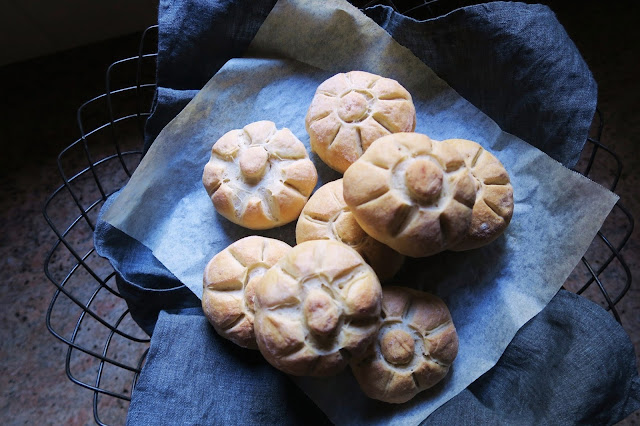
For those who wish to bring sfincione into their own kitchen, Lindsay guides you below. I made it for my family, and shared the photos in the opening of this post. I chose to add the anchovies on one half and half without, topped with tomato, cheese and the breadcrumbs. A must try!
The "No Recipe Tradition: Lo Sfincione
Years ago, when my husband and I found ourselves with an abundance of Roma tomatoes (typically used for sauces rather than salads), I began researching and practicing canning. That led to some really great sauces, and rather than use them all on pasta, I learned how to make pizza. I attended a Scuola di Pizza class at Mozza Pizzeria, owned by Nancy Silverton, who has won the James Beard Foundation’s Outstanding Chef Award.
Using her recipe, combined with what I remembered from Nonna’s technique (minus the anchovies and cheese, as I am vegan), I began preparing batches of thick-crust pies. I often made mine round rather than rectangular, a modern spin on a Sicilian classic.
I don’t have a fancy oven like Nancy, and neither did Nonna. I set my oven to 500 degrees Fahrenheit after sliding in eight fire bricks, which you can find at most hardware stores. Just place them on the racks above and below where you’ll cook your pizza.
Use a well-greased pan. For a more classic presentation, opt for a 10x16-inch rectangular cookie sheet. Press the dough onto the surface, top it with anchovies and/or sauce, breadcrumbs and/or cheese, and drizzle the top with olive oil. Bake it until the bottom is browned (you’ll see this when you carefully lift it with a spatula) and the breadcrumbs are crisp. Leave it in the oven for about 12 minutes. Then, slide it out, and cut the sfincione into squares, which you can serve hot or at room temperature. Refrigerated slices also make a great breakfast.
Author Note
Lindsay Marie Morris is the author of The Last Letter from Sicily and Beneath the Sicilian Stars, novels inspired by family history, memory, and the untold stories of wartime Sicily.
Part of The Sicilian Table: Scacce & Stories — a collection of recipes, memories, and the stories that were never written down.
If scacce or impanate are part of your family tradition, or you know of someone who would be interested in sharing a family recipe for these Sicilian pies, please email me at: theheirloomchronicles@gmail.com
With your permission, selected recipes and stories will feature as part of my series - The Sicilian Table: Scacce & Stories.
If you enjoyed reading this post, please share it!
With Love,
Carmen Xx

.jpeg)
Good post. I am offering SEO services for new businesses. Visit to check more info Digital Marketing
ReplyDelete