
Comfort food, whether it be a way of fulfilling a food desire and therefore satisfying a craving, or having an amazing ability to echo a connection with time, comfort food without a doubt generates contentment. Preparing a comfort food that elicits a memory from our past is what Marcel Proust called a 'Proustian moment'; the journey of memory on which we go on and through that journey the resurrection of memories of those who cared for us in the past. These are dishes that we remember our mothers and grandmothers preparing - good food served at their tables that convey their love for us. Memories of when we knew beyond question that someone cared for us through the act of placing food in front of us and saying mangia! mangia! (eat!)
In this post, not only am I sharing a recipe for a Sicilian pie typical of the region of Ragusa, but also making a call out for any Sicilian friends out there who would like to be part of a project I am currently working on. More about this later.
I have written a previous post on our family's much loved scacce (Sicilian pies or focaccia like stuffed breads), the ones my mother in law was very good at making with different fillings and that we continue to make in honour of her memory. The recipe I share with you here was kindly passed onto me by Jessica, an Instagram friend who agreed that this Sicilian pie should also be shared, and in doing so her nonna Agata's recipe will be kept alive along with so many happy memories linked to it. Jessica remembers her nonna as a brilliant cook:
'The queen of the kitchen and well known in Ragusa for hosting her summer dinners in the countryside for up to 30 - 40 people at a time. She was brilliant in cooking rabbit, making torrone, cassatelle and cooking in amazing ways all kinds of vegetables, meat and pasta. One of her masterpieces was le scacce, and would make a large quantity filled with any kind of fillings depending on the special occasion and season. Eggplants, peas and fava beans would be the Spring fillings, while lamb would be reserved for the special Easter vigil meal which they called impanate...and of course the mille-feuille scaccia stuffed with fresh tomato sauce, basil and a Ragusan cheese called caciocavallo'.
Sicily is a region of Italy I visited with my family, and it was our mission to taste as many different scacce we could find. Apart from the importance of discovering in great depth my husband's roots, it was also a place that has always intrigued me with its rich history and strong food culture that is mixed with local specialties and influences from its past invaders. A must for anyone to discover. Then there's the true 'cucina povera' that speaks of simplicity and seasonal ingredients coming together in traditional dishes, personalised by le nonne (grandmothers) of each town. Dishes that are only found in some provinces and not others such as these scacce.
What I have learnt thus far with regards to scacce, is that each town and family in the south east side of Sicily has their own recipe or filling for this pie. As Jessica pointed out to me, the slightest differences are seen from town to town. She remembers the scacce of her grandmothers sister being very different to her grandmother's and what is apparent about this dish is that most families from this part of Sicily have personalised their scaccia and claimed it their own.
In the town of Modica, scacce are made with tomato and parsley while in a nearby town they are made with tomato and fried onions. This I originally noticed in my husband's family, where my mother in law who was from a town called Vittoria had her own favourite fillings, while my father in law from Palazzolo Acreide had his. You can read more about these varied fillings in my previous post Sicilian pies - you say 'mpanate, we say scacce There are many focaccia like stuffed breads, differently shaped with varied fillings all over Sicily, but you will only find scacce in the south east side. In Palermo they are referred to as sfincione and impanata, while in other regions they are known as nfigghiulata, fuazza, ravazzata and scacciata. They are also sold as street food and when made smaller, they also make the best finger food for parties.
Agata's Scacce con le Mulinciane (Sicilian Pies with Eggplants)
The recipe for this filling has been adapted from nonna Agata (Jessica's grandmothers' recipe) The quantity is for 4 large sized scacce or 6 to 8 small scacce.
Please note: quantities are "al occhio" (not exact quantities) as this is how our Italian nonne and mamme like to cook.
Ingredients for filling:
- 1 kg of eggplants (5 large)
- 1 small onion
- 4/5 tablespoons of toasted breadcrumb (as Jessica says in Sicilian dialect, the breadcrumb needs to be to 'abbrustolito' or 'atturratu'. I toasted my own bread and then processed it, however you can use bought breadcrumbs)
- 1 tsp of capers, cut in small pieces
- small bunch of basil leaves
- 2 or 3 tblsp of parmesan cheese or grated caciocavallo cheese
- 5 or 6 tablespoons of tomato sauce (as Jessica claims - better if it is home made!)
- almonds cut into small pieces (quantity to taste - I used 1/2 a cup)
- 5 tbsp of olive oil
- salt & pepper to taste
Ingredients for bread dough pastry:
The traditional pastry for the casing of the scacce is a bread dough pastry. Although Jessica did not forward this, it goes without saying that this is what our Sicilian nonne would have used. The recipe for this bread dough pastry is from my previous post on scacce. It makes about 6 or 8 small scacce.
- 4 cups of bread flour, plus extra for dusting
- 1 tsp of sugar
- 7 g of instant dried yeast (1 sachet)
- 2 tbsp of olive oil
- 1 tsp of salt (adjust to taste)
- 1 cup of tepid water
- olive oil for brushing
Cut onions in small pieces, fry and set aside. Cut eggplants in slices, fry and set aside. When the eggplants are almost cold, cut them into smaller pieces. Jessica's nonna would do this with her hands, so as to have some thin and long pieces of eggplants. Chop the almonds, capers, basil and add to the mixture in a mixing bowl. Add the tomato sauce, toasted breadcrumbs. Mix with a spoon or with your hands, season with salt and pepper, taste and adjust. You may need to add some olive oil or more breadcrumbs. The breadcrumb helps absorb some of the moisture created by the sauce. The mix should be softer than a raw meatball mixture but not too soft, otherwise it will come out from the pie if it isn't sealed securely. Allow the mixture to cool while preparing the dough.
Place the flour in a large bowl. In a cup of tepid water, mix yeast and a teaspoon of sugar and allow the yeast to froth and activate. Pour into flour with olive oil and salt and mix with a wooden spoon to bring the dough together. Transfer to a floured work surface and knead until the dough is smooth. Alternatively you can complete this step using a stand mixer with a dough hook attachment. Transfer the dough to a bowl, cover with lid and allow to rest for 20 minutes. Once raised, divide the dough into 8 balls and cover those that you are not kneading with a clean tea towel and knead for a further 5 minutes each ball. Cover and allow them to rest for another 20 minutes.

Preheat the oven to 210 C (410 F) and line 2 trays with baking paper. Roll out each ball to a 20 cm diameter disk. Fill one side of the circle with the eggplant mixture, moisten the edge of the casing with water and fold over the dough. Pinch the edges with your fingers and fold the edge into itself as you move around the half circle. Jessica calls this method by its Ragusan dialect 'rieficu'. Alternatively you can use a fork to press down the edges so that the scacce are fully sealed.
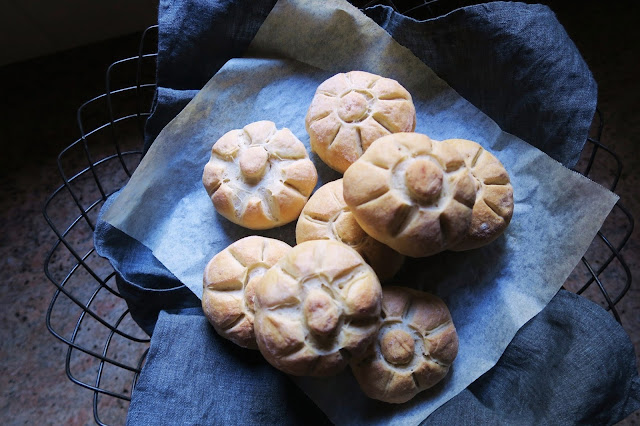
The twist of the edges has taken me a little practice, but once mastered you won't turn back. I also pierced the tops with the prongs of a fork, more for decoration than anything else. This is optional and a method my mother in law would use to differentiate the variously filled scacce from the rest. She would also encase each filling differently. Some would be round, some oblong and others half-moon. Brush the scacce with some olive oil before baking in a hot oven. Our grandmothers would use a wood fired oven and therefore these pies would cook quickly like pizzas. As all the ingredients used in these pies are either pre-cooked or require little cooking, it is really only to cook the bread casing.
These scacce are so deliciously wholesome and comforting and make a great vegetarian meal too. If you omit the cheese like I did with some for my vegan daughter, they get the tick of approval for being 100% vegan. I would like to thank Jessica for sharing her nonna's recipe and story with us. It has given me a better insight into the varied fillings and names for this Sicilian pie. I hope I have done your nonna's scacce justice, and as you know it isn't easy re creating someone else's recipe when they cooked 'al occhio', so thank you to Jessica and to your nonna for the guidance. This type of scaccia is one that I will make again and will also try my hand at the mille-feuille scaccia stuffed with fresh tomato sauce, basil and caciocavallo.
CALLING ALL SICILIAN COOKS!
If scacce or impanate are part of your family tradition, or you know of someone who would be interested in sharing
a family recipe for these Sicilian pies, email me at: theheirloomchronicles@gmail.com
With your permission, selected recipes and stories will feature on the blog as part of my series:
The Sicilian Table: Scacce & Stories.
Please share this post!
With Love,
Carmen Xx



Comments
Post a Comment